For many households, Itabashi can be a good place to live. It remains inside Tokyo's 23 wards while offering several distinct rail corridors, long-established shopping streets, quieter residential blocks, and a broad mix of apartments, condominiums, and houses. The important question is not whether the ward is “good” in the abstract, but which part of Itabashi fits your commute, budget, household, and preferred daily routine. This guide connects the train lines and local history with the terrain beneath the streets, using official English hazard maps to help you make a more informed shortlist.
Is Itabashi a good place to live?
Itabashi is on the northwestern side of Tokyo's 23 special wards. Its residential areas are connected by the Tobu Tojo Line, JR Saikyo Line, Toei Mita Line, Tokyo Metro Yurakucho and Fukutoshin lines, buses, and local cycling routes. This gives households more than one way to balance access and space—but it also means that two Itabashi addresses can produce very different commutes.
Multiple rail corridors, everyday shopping, varied housing, and access to central Tokyo.
Peak-hour crowding, the walk to the station, traffic, noise, slopes, and address-level flood risk.
Repeat your real weekday journey and walk the neighborhood in the evening and on a weekend.
Itabashi City's English-language Welcome to Itabashi guide covers registration procedures, health insurance, tax, childcare, emergency information, libraries, sports facilities, and daily-life rules. That kind of municipal support is useful after moving, especially for residents still learning how local procedures work in Japan.
A post town before it was a commuter neighborhood
Itabashi has a much older story than its railway suburbs. In the Edo period, Itabashi-juku was the first post town on the Nakasendo after leaving Nihonbashi. Its settlement stretched for about 1.7 kilometres and was divided into Hirao-juku, Naka-juku and Kami-juku. Travellers, goods and the people who served them helped the town prosper.
The old Nakasendo around today's Nakajuku is a useful place to start exploring this history on foot. Historic sites and the old road give this area a different context from the planned residential streets around Tokiwadai or the later development of Takashimadaira. They are all Itabashi, but they did not grow in the same way.
The ward archives also describe Itabashi-juku's role in checking the weight of transported goods. It was part of a working transport network, as well as a place for travellers to stop. Do not confuse this Nakasendo post town with the separate Kami-itabashi-juku on the Kawagoe Kaido.
Choose the railway corridor around your destination
Itabashi is served by several railway corridors, so the most useful station depends on where you go each day. A home near one line may be a much better fit than an equally attractive home on another. These are route comparisons; journey times vary with the service, time of day and walk at each end.
Toei Mita Line · Otemachi and Hibiya
Shin-Itabashi, Itabashi-kuyakusho-mae, Itabashi-honcho and the Shimura stations connect with Hasune, Nishidai and the Takashimadaira stations. The line continues through Sugamo, Otemachi, Hibiya and Mita to Meguro.
What changes along the line: the historic ward-office area, the plateau edge around Shimura and the northern lowlands offer very different streets and terrain. Sharing a train line does not mean sharing the same flood exposure.
Tobu Tojo Line · shopping streets and residential districts
Oyama, Naka-Itabashi, Tokiwadai, Kami-Itabashi, Tobu-Nerima, Shimo-Akatsuka and Narimasu lie along the route to Ikebukuro. Compare the service that actually stops at your station; express and local stopping patterns differ.
What changes along the line: Oyama's shopping district, Tokiwadai's residential streets and the Narimasu interchange area suit different routines. Check the walk and the station exit as closely as the railway map.
Yurakucho & Fukutoshin lines · beyond Ikebukuro
Chikatetsu-Narimasu, Chikatetsu-Akatsuka and Kotake-mukaihara serve nearby Itabashi neighborhoods. The Yurakucho Line reaches Iidabashi, Ichigaya, Nagatacho, Yurakucho and Toyosu. The Fukutoshin Line reaches Shinjuku-sanchome, Meiji-jingumae and Shibuya.
What to compare: the walk to the subway versus the Tojo station, the destination and stopping pattern of the train, and the exit nearest your workplace. Chikatetsu-Akatsuka and Kotake-mukaihara have official station addresses in Nerima; Chikatetsu-Narimasu is in Itabashi. All are relevant to a home search near the ward boundary.
JR Saikyo Line · Shinjuku and Shibuya
Homes around JR Itabashi / Shin-Itabashi, and around Ukima-Funado in the north, may suit a Saikyo Line commute. Check the distance to each station separately and test peak-hour conditions. JR Itabashi and Shin-Itabashi are different stations.
How to think about rent and purchase prices
There is no single “Itabashi price.” Rental and purchase markets differ, and each property is affected by station, walking distance, size, age, floor, orientation, condition, land share, management, and market timing. Use several layers of evidence rather than one headline average.
For buying, the Ministry of Land, Infrastructure, Transport and Tourism's Real Estate Information Library lets you review transaction-price information, official land prices, disaster information, planning information, and nearby facilities. Recent transactions are generally a better starting point for a resale home than a broad ward average, but they still need adjustment for the subject property.
In the Tokyo Metropolitan Government's 2026 public land-price data, Itabashi's average residential benchmark was about 39% below Toshima and 74% below the central five-ward average. This supports Itabashi's relative affordability compared with central Tokyo, but it does not mean an Itabashi home costs 74% less. Public land prices are selected land benchmarks, not rents or complete home prices.
Seven areas to compare, street by street
Use these area groups to plan viewings. Each covers more than one kind of street; a station name or neighborhood label is too broad to settle the housing or hazard question.
Oyama / Nakajuku / the ward-office area
Start here if everyday shopping and an established urban neighborhood matter to you. Oyama's Happy Road and Yuza shopping streets have a different setting from the old Nakasendo around Nakajuku.
- Railway fit
- Tobu Tojo at Oyama or the Mita Line at Itabashi-kuyakusho-mae, depending on the address.
- On the viewing walk
- Check which shops are on your actual route, redevelopment works, traffic and evening noise. Near the Shakujii River, consult the smaller-river map.
Tokiwadai / Kami-Itabashi / Naka-Itabashi
Compare the Tojo Line's residential streets and local shopping. Parts of Tokiwadai 1–2 chome north of the station have dedicated streetscape guidelines; this does not describe every street around Tokiwadai.
- Railway fit
- The Tojo corridor toward Ikebukuro. Check stopping patterns for the particular station.
- On the viewing walk
- Compare the north and south sides, major-road noise, slopes and shops. Plateau streets and the Shakujii River valley can be close together, particularly toward Naka-Itabashi.
Narimasu / Akatsuka / Shimo-Akatsuka
This is worth exploring when access to both Tobu and Tokyo Metro suits the household. The wider Akatsuka area also has gardens and historic places to visit, though these may be a substantial walk from the station.
- Railway fit
- Tojo services plus Yurakucho and Fukutoshin services near Chikatetsu-Narimasu or Chikatetsu-Akatsuka.
- On the viewing walk
- Test the route to each station. Check slopes and local valleys, including the Shirako River side, rather than treating the whole western area as uniformly high ground.
Mukaihara / Kotake-mukaihara
Consider southern Itabashi around the ward boundary if the Yurakucho or Fukutoshin route matches your daily destination. The nearest convenient station entrance matters more than the ward name in the station address.
- Railway fit
- Tokyo Metro toward Iidabashi / Yurakucho or Shinjuku-sanchome / Shibuya.
- On the viewing walk
- Check the exact walk, supermarkets, crossings and local low points. A southern address still needs an inland-flood map check.
Shimura-sakaue / Shimura-sanchome
Shimura is a transition area between plateau, slopes and lowland. Two properties around the same station can have noticeably different elevation and walking conditions.
- Railway fit
- Mita Line toward Sugamo, Otemachi and Hibiya.
- On the viewing walk
- Walk the full uphill and downhill route. Check the terrain, flood and landslide maps, as well as retaining walls and the building's position relative to the slope.
Hasune / Nishidai / Takashimadaira / Funado
The northern area includes large housing developments and access to riverside open space. Takashimadaira's approximately 2.5-kilometre green belt offers a walking route along the Mita corridor.
- Railway fit
- Mita Line stations across Hasune, Nishidai and Takashimadaira; some Funado homes are more convenient for JR Ukima-Funado.
- On the viewing walk
- Much of this area is low-lying. Prioritise the Arakawa flood-depth and duration maps, routes to higher ground and the building's flood preparations. Nishidai's wider neighborhood also includes higher terrain, so locate the actual plot.
JR Itabashi / Shin-Itabashi / nearby Kaga
Compare this area if JR and Mita Line options are useful. The Shakujii River around Kaga is also part of the local landscape; riverside appeal and flood checks belong in the same decision.
- Railway fit
- Saikyo Line at JR Itabashi and Mita Line at Shin-Itabashi, with different walks from each property.
- On the viewing walk
- Check rail and road noise, density, the route between stations and whether the property sits in or beside the river valley.
Understand the ground: northern lowlands and the southern plateau
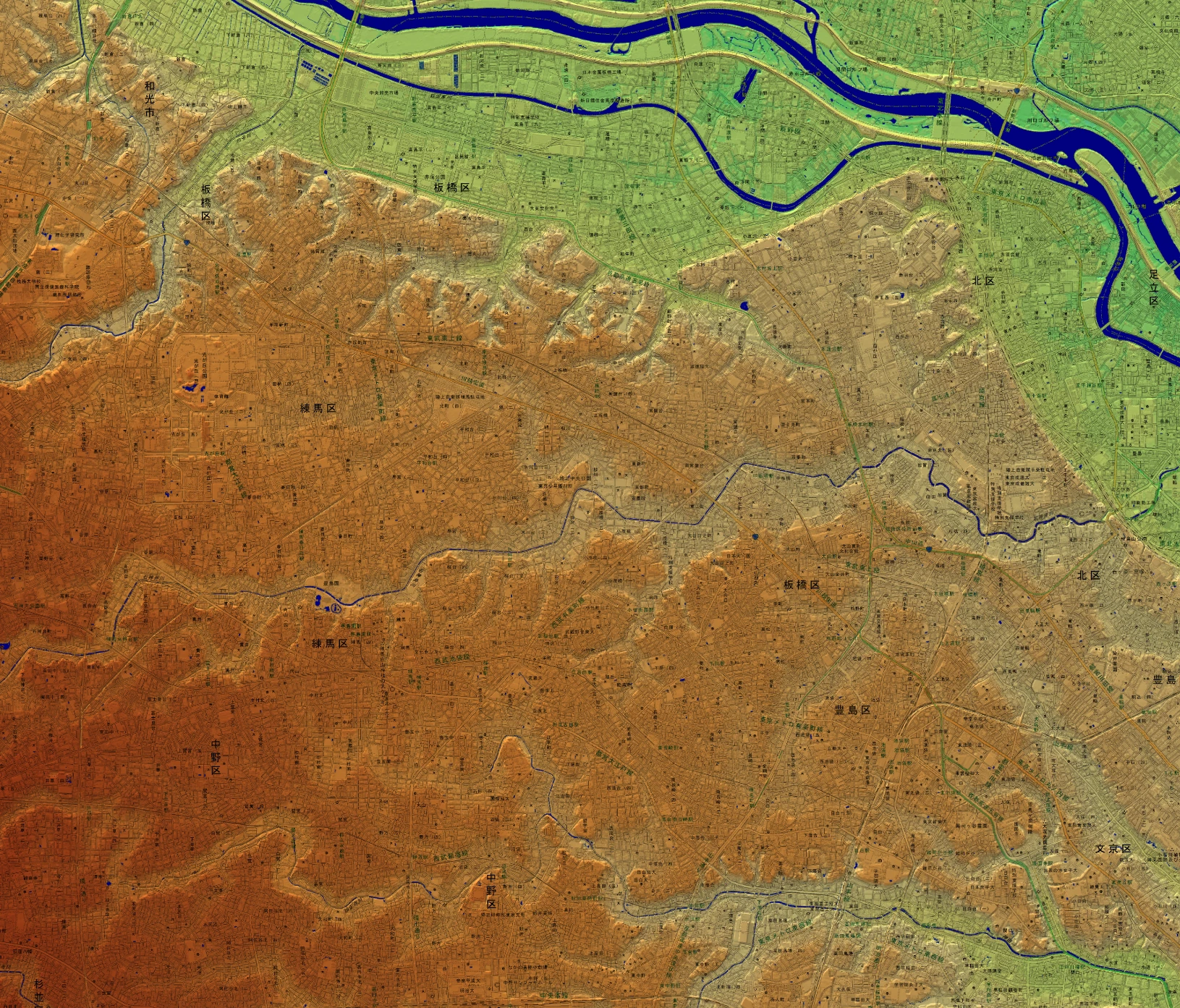
Itabashi City describes its terrain as a combination of the Musashino Plateau, around 30 metres above sea level on average, and the Arakawa's alluvial lowland. Broadly, the north is lower and the south is higher. The ward's highest and lowest locations differ considerably; a north–south rule is only a starting point.
How to read the terrain
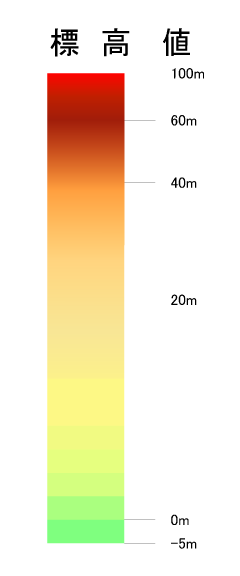
North is at the top. The green northern lowland meets the higher yellow-to-orange plateau along a visible escarpment. Narrow valleys cut into that higher ground. The original legend measures elevation above sea level, not flood depth. Place names on this map are in Japanese; the flood maps below are in English.
Explore the original terrain layer in GSI Maps ↗
The official river-flood map shades extensive northern areas, including parts of Takashimadaira, Hasune and Funado. This is why the flood-depth map, duration map and evacuation arrangements are important when comparing homes here.
Many higher plateau locations lie outside that mapped inundation area. This relative advantage applies to the specific river-flood scenario; it does not mean every southern address has low risk from every kind of flooding.
The Shakujii River cuts through the southern part of the ward. Other local valleys, low points and steep slopes also interrupt the plateau. Check smaller-river flooding, rainwater flooding and landslide designations separately.
For daily life, the same terrain affects whether your walk home is uphill, how practical cycling feels and how easy the route is with a stroller or shopping. Walk the actual route before deciding.
Three flood maps answer three different questions
Find the building on each map, then follow the routes to the station and an appropriate evacuation destination. The figures below are official English maps, with their original legends. Open the full PDF for street-level reading; the small page preview is an overview.
1. Arakawa flooding: the northern lowland pattern
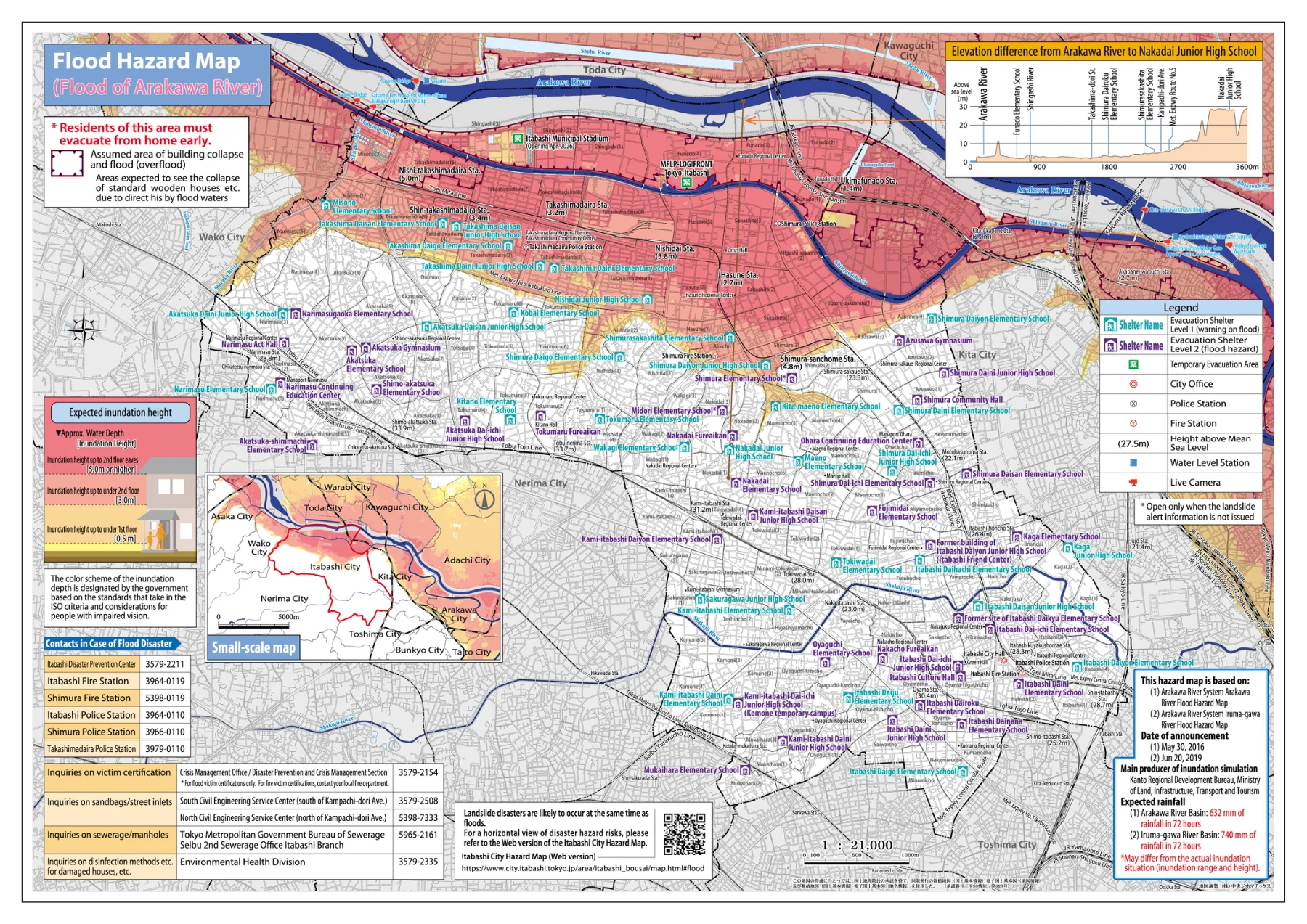
Open the full-resolution English map and legend (PDF) ↗
The Arakawa scenario assumes the maximum-scale rainfall used in the official model: 632 mm over three days in the river basin. The colours represent modeled water depth above ground, not the probability of flooding in a particular year. The northern lowland pattern is clear, while many southern plateau areas are unshaded.
Also open the English inundation-duration map. Deep water and water that takes a long time to recede create different practical problems. Ask about the building's entrance, electrical equipment, water supply, lifts and flood-response arrangements. An upper-floor room does not by itself resolve access or utility disruption.
2. Smaller rivers: look closely at the Shakujii River valley
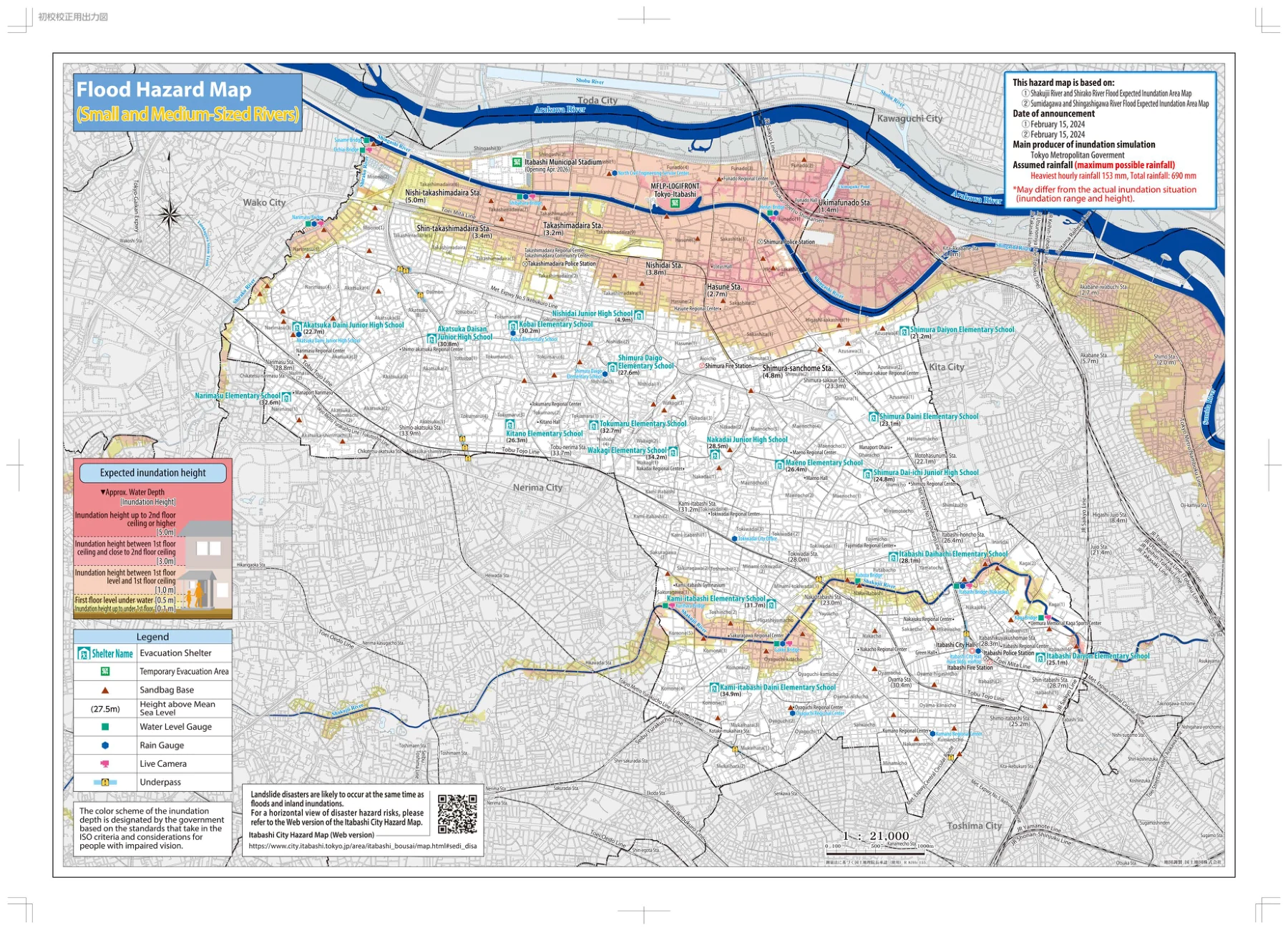
Open the full-resolution English map and legend (PDF) ↗
This map covers the Shakujii, Shingashi and Shirako rivers. It shows why an address in the south cannot be judged from the Arakawa map alone. Pay attention to the valley around the actual property, bridges and the route you would use to leave the area.
The ward's August 2026 revision uses the maximum rainfall scenario of 153 mm in one hour and 690 mm in total. These are modeling assumptions, not a forecast for the next storm. Compare this map independently from the Arakawa scenario.
3. Inland flooding: rainwater can collect away from a large river
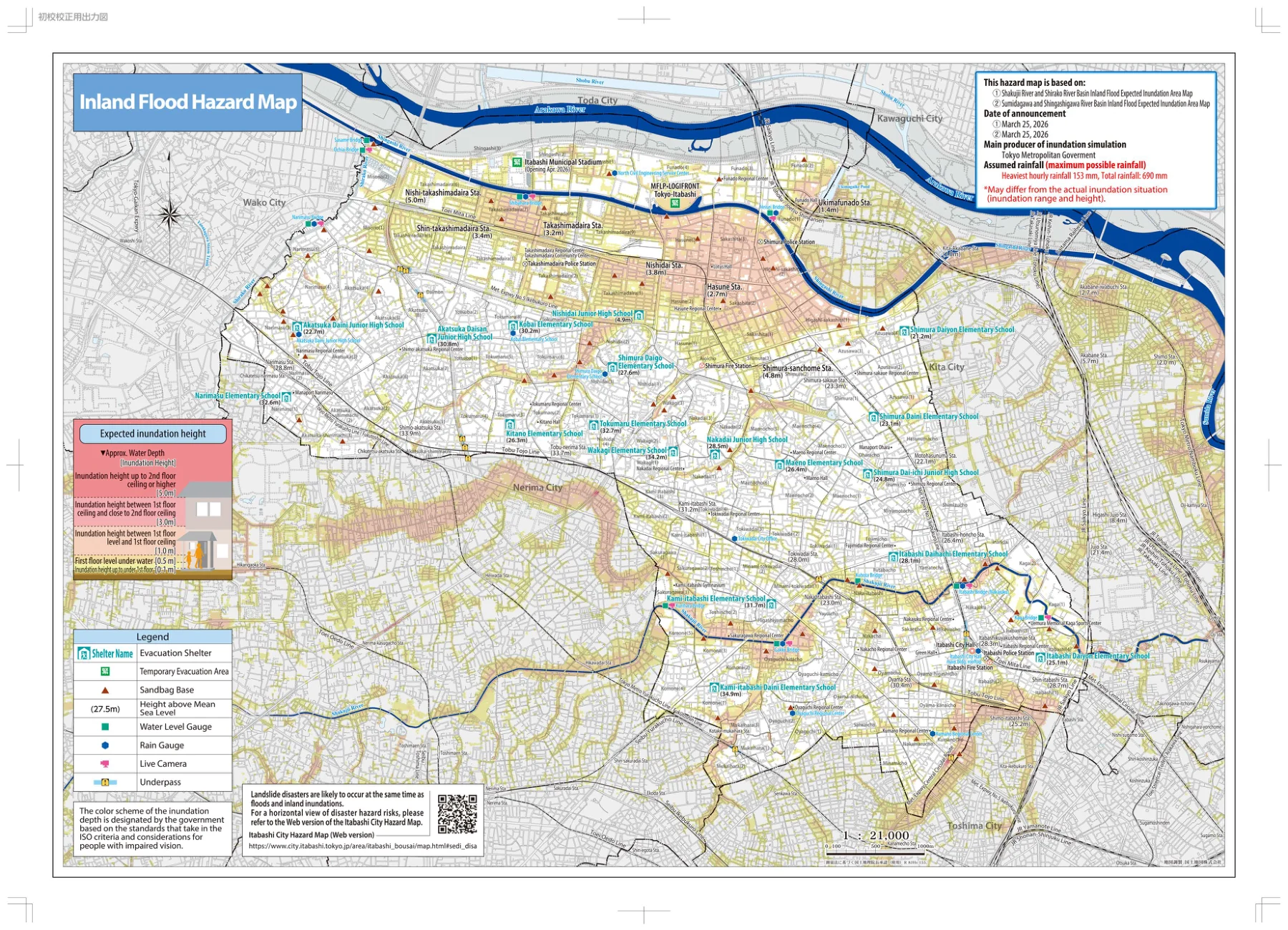
Open the full-resolution English map and legend (PDF) ↗
Intense rain can overwhelm drainage or prevent water from being discharged. The inland-flood map therefore shows a different pattern, including localized patches away from the main riverbanks. Check low entrances, basement rooms, underground parking and underpasses along your everyday route.
The map cites Tokyo's March 2026 inland-flood inundation data. Check its legend separately: matching colours across different maps should not be assumed to mean identical categories or scenarios.
What foreign residents should check when renting or buying
The property search is only one part of the process. Language, identification, screening, finance, registration, and immigration are separate topics. Ask what documents and explanations will be available in English before paying an application or reservation fee.
When renting
- Application documentsConfirm the required identification, residence card or passport, employment and income evidence, emergency contact, and move-in date.
- Guarantor arrangementsAsk whether a guarantee company is required, its initial and renewal fees, and whether a personal guarantor is also requested.
- Upfront moneyRequest an itemized estimate covering deposit, key money, brokerage, guarantee fee, insurance, lock change, and other charges.
- Contract termsCheck whether the lease is ordinary or fixed-term, how renewal and cancellation work, and which costs may apply at move-out.
- Condition recordPhotograph and document the room at handover so existing wear is distinguished from later damage.
MLIT's official Apartment Search Guidebook is available in English and 13 other languages. It explains the search and lease process and provides multilingual checklists and sample documents. Use it before signing, not only after a problem appears.
When buying
- Cash purchase and mortgage are differentLoan eligibility, required residence status, income history, down payment, and accepted documents are lender-specific. Obtain financing guidance early.
- Registration documents depend on residenceThe Ministry of Justice provides specific address-document guidance for owners living outside Japan. A judicial scrivener should confirm the current documents for your case.
- Non-resident reporting may applyThe Ministry of Finance states that a FEFTA non-resident acquiring Japanese real estate must make a post-transaction report within 20 days under the current rules. Confirm scope and procedure at the time of purchase.
- Residence status is a separate procedureA property purchase is not an immigration application. Confirm visa and status-of-residence questions with the Immigration Services Agency or a qualified immigration professional.
- Plan for ownership after settlementArrange tax notices, insurance, management communication, repairs, utilities, and a Japan-based contact if you will live overseas.
Continue with our guides to buying property in Japan and mortgage preparation for foreign nationals.
Check the property, the route, and address-level risk
Inside, check light, ventilation, storage, furniture layout, sound, water areas, and signs of maintenance needs. For a condominium, also review management, repair planning, reserve funds, rules, shared areas, and meeting records. For a house, confirm road access, boundaries, structure, utilities, and future repair needs.
Condition, light, noise, layout, shared areas, management, and repair history.
Station route, lighting, crossings, traffic, shopping, waste collection, and bicycle storage.
Flood and landslide maps, planning and zoning, nearby facilities, and recent transaction evidence.
Disaster risk varies by exact address and building. Itabashi City's flood information identifies higher expected inundation in parts of Hasune, Funado, and Takashimadaira under the Arakawa maximum-assumption scenario. This does not make a whole neighborhood unsuitable; it means buyers and tenants should compare the official map with the building structure, floor, evacuation route, household needs, and insurance.
Who should consider Itabashi?
Itabashi is worth comparing if you want to remain within Tokyo's 23 wards while considering several rail corridors, residential environments, and property types. It may be less suitable if another part of Tokyo gives your household a materially simpler commute or keeps essential family, school, or work support closer.
Asiascape operates HouseDo Tokiwadai Station South Exit, one minute from the station's south exit, as a local base for Itabashi property support. Browse the HouseDo store website or use our English buying support to compare neighborhoods and properties across Itabashi and Tokyo.
FAQ
Frequently asked questions
Is Itabashi a good place to live?
For many households, yes. Itabashi offers several rail corridors, established shopping streets, parks and a broad mix of homes within Tokyo's 23 wards. Choose the neighborhood by your actual commute, total housing budget and address-level hazard checks.
Which train lines serve Itabashi?
The Tobu Tojo Line serves the Ikebukuro corridor; the Toei Mita Line connects eastern and northern neighborhoods with Sugamo, Otemachi and Hibiya. The Tokyo Metro Yurakucho and Fukutoshin lines serve Narimasu, Akatsuka and the Kotake-mukaihara area. JR Saikyo Line access is another option near Itabashi and Ukima-Funado. Some useful stations are on or beyond the ward boundary.
Does Itabashi have a flood risk?
Yes, and it varies sharply by address. Northern lowlands near the Arakawa include extensive areas of modeled inundation. Many southern plateau locations have less exposure to Arakawa flooding, but the Shakujii River valley, local depressions and drainage flooding still need separate checks. Read the Arakawa, smaller-river, inland-flood, storm-surge and landslide maps for the exact property.
Is southern Itabashi safe from flooding?
Higher ground in southern Itabashi generally has lower exposure to the mapped Arakawa flood scenario than the northern lowlands. That is a broad pattern, not a guarantee. Southern Itabashi also has river valleys and local low points; check the property's location on the smaller-river and inland-flood maps as well as the Arakawa map.
Which part of Itabashi should I compare first?
Start with your destination: the Tojo corridor for Ikebukuro, the Mita corridor for Otemachi or Hibiya, or the Yurakucho and Fukutoshin corridor for destinations beyond Ikebukuro. Then compare the actual station walk, everyday shops, slopes, housing costs and official hazard maps.
What was Itabashi-juku?
Itabashi-juku was the first post town on the Nakasendo after leaving Edo's Nihonbashi. In the Edo period its roughly 1.7-kilometre settlement included Hirao-juku, Naka-juku and Kami-juku. The old route and historic sites remain part of the character of today's Nakajuku area.
Can foreign residents get help finding a home in Itabashi?
Asiascape offers English rental and purchase support from its Tokiwadai office. Tell us your workplace or campus, budget and move-in plans. Rental screening, accepted documents and mortgage eligibility depend on the property and the relevant management company, guarantor or lender.